Walking tours are such a good way to learn about a city. We like to use GuruWalks. Except for a generous tip for the guide, the tour is free. Our guide on the Guatemala City historical street tour was Beverly, a pure delight. We also had great walking partners, Richard and Li from Malaysia. We clicked almost instantly with these two easy-to-know, bright, and fun people. As we walked along, we talked about our mutual travel and life experiences and tossed around issues simmering in our own countries. Now and then, Beverly had to politely interrupt our intense conversations to bring us back on-task so she could pass along info about a new site.
In our 4-hour tour, we walked the length of Avenida de La Reforma and continued on to the end of Las Americas Avenue. When Stan and I walked nearly this entire trek a few days earlier, we merely ogled the monuments and buildings we passed but had little notion of their significance. Now, with Beverly’s information, we know the monuments along the broad, green, park-like Avenida Reforma celebrate politicians, the country’s only Nobel prize winner, the creator of the Red Cross, the composer of the national anthem, and others who played important roles in Guatemala’s development. As Reforma continues across CA-1 at Plaza Obelisco, its name changes to Las Americas, famous for its plazas created by Latin American countries that are a part of the Organization of American States formed in 1948. Avenida Las America ends at Plaza Berlin where visitors come to take in the exceptional view of the southern part of the city and the volcanoes, Agua, Acatenango, and Fuego in the background.
In our walk, Beverly also gave us insight into the area where our apartment is located. Only five years ago it was a deserted area. Buildings were dilapidated, it was a dangerous place, and no one wanted to live there. Transforming Zona 4 was not easy. First, the government tried to renew the area by encouraging random investment, but it became a hoot-and-holler place and home to drug dealers and gang members. Finally, the government stepped aside. Investors formed a coalition, found funding, and started building. Now it is THE place to dine, dance, have a drink, live, and work.
Failed efforts to revitalize blighted areas are an example of government inadequacy. While the government of Guatemala has a sizeable budget, the greatest portion is allocated to national defense, healthcare gets 4%, and education 2%. We were told that if a person without private insurance needs to see a doctor, patients might need to bring their own syringes; doctors might not have basic supplies like gloves or medicine. In public classrooms, there might be desks but most often there are none. No books, no pencils, no tools. Poor people ask, why go? The average monthly cost for a private elementary school is $200 per month per child. While employed people in Guatemala City or Antigua might be able to swing that, indigenous people hardly see $200 a month to live on, plus, kids are seen as valuable assets to help support the family. Forty-nine percent of Guatemala’s population lives remote in rural areas. With no education, there is no change; it is a never-ending cycle. Poverty prevails.
In fairness to our walking tour guide, I gleaned the following important background information in a visit to the Museo de Memoria:
Discrimination against the indigenous people stems from the Spanish conquest. Native peoples of Central and South American countries even today still suffer racial and social injustices that in effect keep them in poverty. Some suggest a revolution against the government that today favors the wealthy and large corporations over its native people. But this country has no appetite for war. It has not forgotten the 36-year civil war that ended in 1996 with the signing of the Peace Accord. That war came about because large companies had control over much of the land and paid zero taxes which led to conflicts with rural indigenous poor who worked the land under miserable terms. Poor rural rebels led by a group of left-wing military officers fought against government forces to gain fair land distribution, tolerable working conditions, and fair pay. About 200,000 people were killed in battles, and in genocides. Another 50,000 simply disappeared. Four hundred villages were completely destroyed, and another 100,000 people fled Guatemala for refuge in Mexico. Ninety-three percent of the casualties were indigenous people. Little changed.
I can’t say enough good things about our walking tour; Beverly was informed and personable. She shared information that isn’t found in guidebooks or without extensive online searches. Plus, she took us to places for foods we would never have found or felt safe in trying. At one of her favorite spots, a parking lot at Parque Los Americas, everyone bought cups of chilled ceviche. Made by a mom and daughter team, and sold out of the back of a red pickup truck, we all agreed, it was among the best, fresh-tasting ceviche any of us ever had outside of Peru. This could have been a foodie tour because later we tried more street food . . . shucos. The Guatemalan hot dogs consist of a grilled bun spread with guacamole and topped with hot grilled chorizo or pork chunks slathered in special sauces. They come out hot, messy, and delicious. Yum!
In our roaming around town a few days later, I saw a billboard promoting the Luz de Navidad at Campo. It is a one-night-only event that happens during the Christmas season. Normally we don’t go out a lot at night but for this event which happened to be nearby, we walked there. It was fabulous. We did not actually make it to the Campo; the massive crowd of people filled the park and spilled out on the entry streets. No problem, our spot on the street provided a splendid view. . . and an easy exit when the show ended. Drone displays, the new thing in sky decorations lit up the sky in festive Christmas displays, but the glory of the night was just being a part of the crowd. We stood amid hundreds or maybe thousands of Guatemalan families, mommas carrying nursing babies, dads carrying tots on their shoulders, young people, and old people, watching the light show followed by a super long spectacular fireworks show.
Guatemalans are very civilized. In the US, everyone murmurs “oohh and ahhh” at the brilliant, sparkling displays exploding in the sky, as if the sight was the first they’ve ever seen. Here people stand in silent reverence and awe, taking it in.
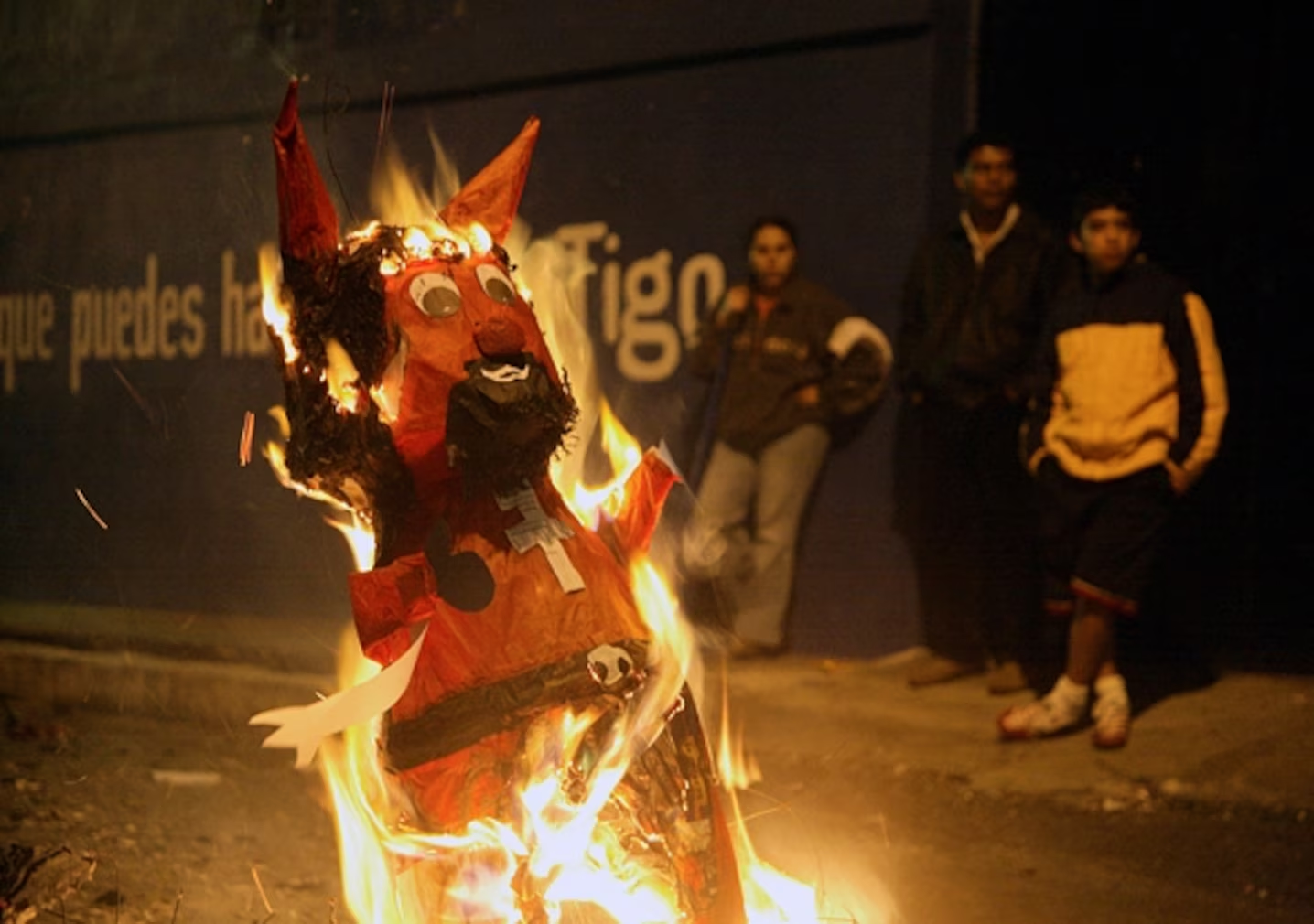
Here is one more unique Guatemalan Christmas celebration. As festive displays and Christmas markets pop up all over town, so do fireworks stands. On Saturday, December 7, these stands also began selling curious-looking red paper pinatas, some small and some quite large. They were evil-looking things, with scary faces, leering grins, and horns.
No wonder, we thought, when we finally learned that these are indeed effigies of the devil. On December 7 at 6 pm, Quema del Diablo, or “Burning of the Devil” takes place. In the tradition that dates back to colonial times, people burn these effigies of the devil on bonfires. The paper devils are filled with firecrackers so they dance and flounce as they burn in front of their house that night to expel evil spirits from the home and welcome the Christmas season. What exciting fun!


❤️🥰🥰❤️
Our long-time house cleaner, Lilia, is from Guatemala. She comes today so I am going to show her your pictures. She will probably get homesick. We feel Lilia is part of our family since she has taken care of our home for about 10 years and takes care of Shirley Kay’s house too.
I hope Lilia liked the photos. And I wish I could have said hello for her to any of her family here.
We’d like to know how Dayna is doing but I hope you both and your entire family are well! We will think of you two as we have a layover in Houston tomorrow on our way to California for an early Christmas celebration with Shea and Tessa. Cody will join us there as well. It will be the first time in two years that we and all our girls are together at the same time. What a joy it will be!